Why a Lower Monthly Payment Costs More Over Time: The Amortization Trap (2026)
📌 Key Takeaways & Executive Summary
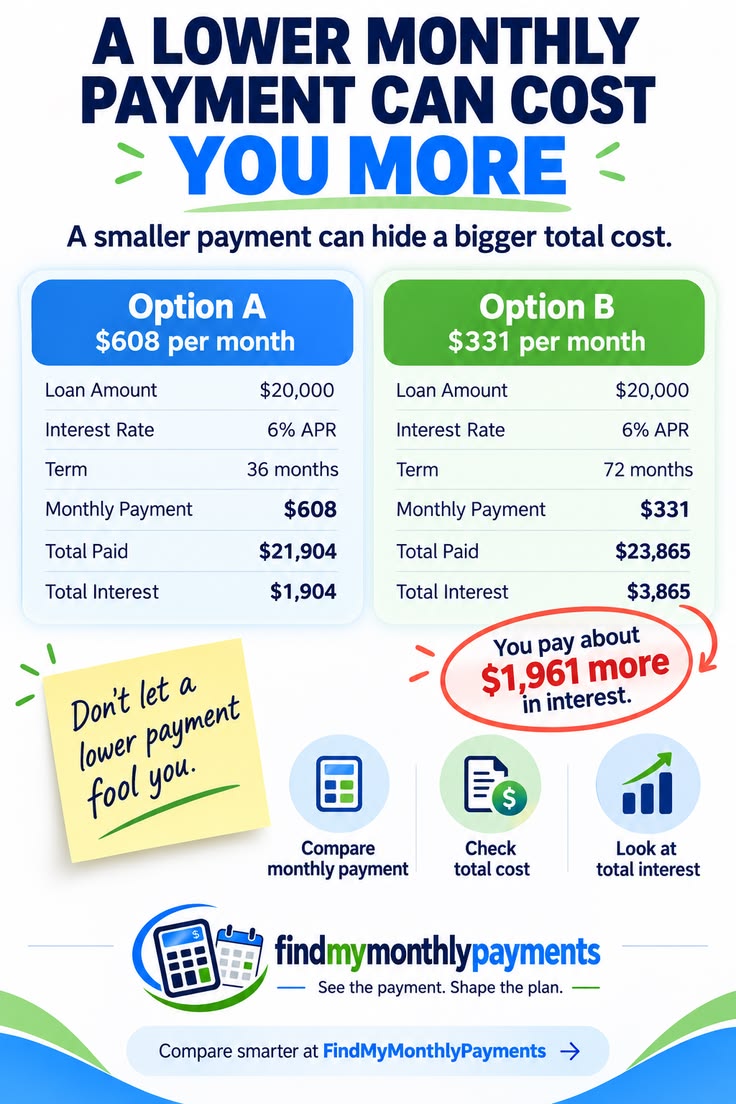
- The Term Paradox: Lengthening your loan term cuts your required monthly payment today, but vastly expands the duration that daily interest accrues.
- Negative Amortization Risk: Inadequate monthly payments fail to cover interest charges, causing the unpaid loan balance to expand over time.
- Interest Doubling: Stretching a $50,000 balance from 10 to 25 years reduces monthly bills by $224, but increases lifetime interest from $18,129 to $52,835.
- Cash Flow Balance: Use extended plans only for short-term emergency breathing room, transitioning back to aggressive prepayment as income grows.
When borrowers experience tight monthly budgets, extending repayment terms from 10 years to 20 or 25 years seems like an obvious, painless solution. On paper, cutting your monthly bill from $550 to $330 feels like an instant $220/month pay raise.
However, this short-term relief is an expensive financial mirage. In the world of actuarial lending, a lower monthly payment is the single most expensive decision you can make over your lifetime. In this guide, we analyze the mathematical mechanics of term extension, explain the compound interest trap, and show how to navigate payment plans safely.
1. The Extended Term Trap: Compounding Over Decades
Lenders calculate interest daily based on outstanding principal. When you lengthen your repayment term:
- Your monthly installment decreases because the principal is sliced across 240 or 300 months instead of 120 months.
- Because principal decreases much more slowly, your principal balance remains elevated for decades.
- Consequently, you pay daily interest on a high principal balance for 15 additional years.
2. Lifetime Cost Comparison: $50,000 at 6.5% Fixed APR
Examine this definitive comparison of a $50,000 student loan balance across three common repayment timelines:
| Repayment Plan | Monthly Payment | Total Payments | Total Lifetime Interest | Extra Cost vs. 10-Year |
|---|---|---|---|---|
| 10-Year Standard | $567.74 | 120 | $18,128.80 | $0.00 (Baseline) |
| 20-Year Extended | $372.79 | 240 | $39,469.60 | +$21,340.80 |
| 25-Year Extended | $337.60 | 300 | $51,280.00 | +$33,151.20 |
The Shocking Reality: Lowering your payment by $230/month on the 25-year plan costs you an extra $33,151 in pure interest. You pay more in interest than the entire original $50,000 balance!
3. Negative Amortization: When Balances Grow Despite Paying
If your monthly payment under certain older income-driven plans is smaller than the monthly interest charge, you enter Negative Amortization. For example, if your loan generates $250/month in interest but your payment is set at $150, the unpaid $100 accumulates. After 5 years of perfect, on-time payments, you owe more than when you graduated!
4. How to Use Extended Plans Safely Without Losing Wealth
If financial necessity forces you into a 20- or 25-year plan to survive an entry-level salary, treat it as a temporary safety net:
- Enroll in the extended plan to legally lower your required minimum payment and protect your credit score.
- As soon as you earn a pay raise, make voluntary extra payments above the minimum.
- You preserve the flexibility of a low required payment during emergencies while keeping lifetime interest minimized.
5. Frequently Asked Questions (FAQ)
Does extending my repayment term hurt my credit score?
No. Enrolling in an extended or income-driven repayment plan with your servicer is completely legal and in good standing. Your credit report will reflect on-time payments as long as you meet the new agreed minimum.
Can I switch back to a 10-year plan after enrolling in an extended plan?
Yes! Federal student loan borrowers have the legal right to change repayment plans at any time through StudentAid.gov or by contacting their loan servicer without paying any fees or penalties.
How does the SAVE plan prevent negative amortization?
Under the federal SAVE plan, if your calculated monthly payment does not cover the full monthly interest, the federal government subsidizes and waives 100% of the remaining unpaid interest, ensuring your loan balance never grows.

Written by Marcus Vance, CFP®®
✓ Fact-Checked & ReviewedLead Financial Aid & Student Debt Strategist
Marcus Vance is a Certified Financial Planner (CFP®®) specializing in higher education financing, federal loan restructuring, and student loan repayment optimization. He has analyzed hundreds of student debt portfolios to help graduates minimize interest and achieve debt freedom.