How to Calculate Student Loan Payments: Amortization Formulas & Payoff Scenarios (2026)
📌 Key Takeaways & Executive Summary
- Actuarial Amortization: Fixed student loan payments follow annuity mathematics where early installments primarily pay interest.
- The Standard 10-Year Benchmark: Standard federal repayment divides the loan into exactly 120 equal monthly installments.
- Interest Rate Leverage: On a $40,000 balance, dropping your interest rate by 2% saves over $4,800 in lifetime interest.
- Term Trade-Off: Extending repayment from 10 to 20 years cuts monthly payments by roughly 35% but doubles cumulative lifetime interest charges.
Every student loan calculator operates on standardized actuarial mathematics. Understanding how your monthly bill is derived empowers you to audit your loan servicer's calculations, simulate accelerated repayment strategies, and project exact debt-freedom milestones.
When you sign for an educational loan, your lender locks in three variables: your principal balance, your annual percentage rate (APR), and your repayment term. In this guide, we demystify the formula behind your monthly statement and illustrate how small changes in interest or term length dramatically alter your total lifetime financial commitment.
1. The Standard Loan Amortization Formula
To determine the exact fixed monthly payment (M) required to fully amortize an initial principal balance (P) over a total number of monthly payments (n) at a monthly interest rate (r), financial institutions utilize the following standard amortization formula:
Where the individual components represent:
- P (Principal): The total unpaid loan balance at repayment inception.
- r (Periodic Monthly Rate): Your stated annual interest rate divided by 12 (e.g., 6.5% APR = 0.065 ÷ 12 = 0.0054167).
- n (Total Installments): The total number of monthly payments (e.g., a standard 10-year term = 120 months; a 20-year term = 240 months).
📐 Manual Calculation Example
Assume a student owes $30,000 at a fixed rate of 6.0% APR over a standard 10-year term (120 payments).
• Monthly rate r = 0.06 ÷ 12 = 0.005.
• Factor (1 + r)¹²⁰ = (1.005)¹²⁰ = 1.8194.
• Numerator = 0.005 × 1.8194 = 0.009097.
• Denominator = 1.8194 - 1 = 0.8194.
• Ratio = 0.009097 ÷ 0.8194 = 0.011102.
• Monthly Payment M = $30,000 × 0.011102 = $333.06 per month.
• Total Repaid across 120 payments = $39,967.20 ($9,967.20 pure interest).
2. Comparative Repayment Scenarios Across Loan Balances
To visualize how balance scale and interest rates interact under the standard 10-year repayment schedule (assuming an average 6.5% fixed interest rate), consider the following actuarial breakdown:
| Loan Principal | Monthly Payment (10-Yr) | Total Interest Paid | Total Lifetime Cost |
|---|---|---|---|
| $15,000 | $170.32 | $5,438.40 | $20,438.40 |
| $30,000 | $340.64 | $10,876.80 | $40,876.80 |
| $50,000 | $567.74 | $18,128.80 | $68,128.80 |
| $75,000 | $851.60 | $27,192.00 | $102,192.00 |
| $100,000 | $1,135.48 | $36,257.60 | $136,257.60 |
3. The 10-Year vs. 20-Year Term Dilemma
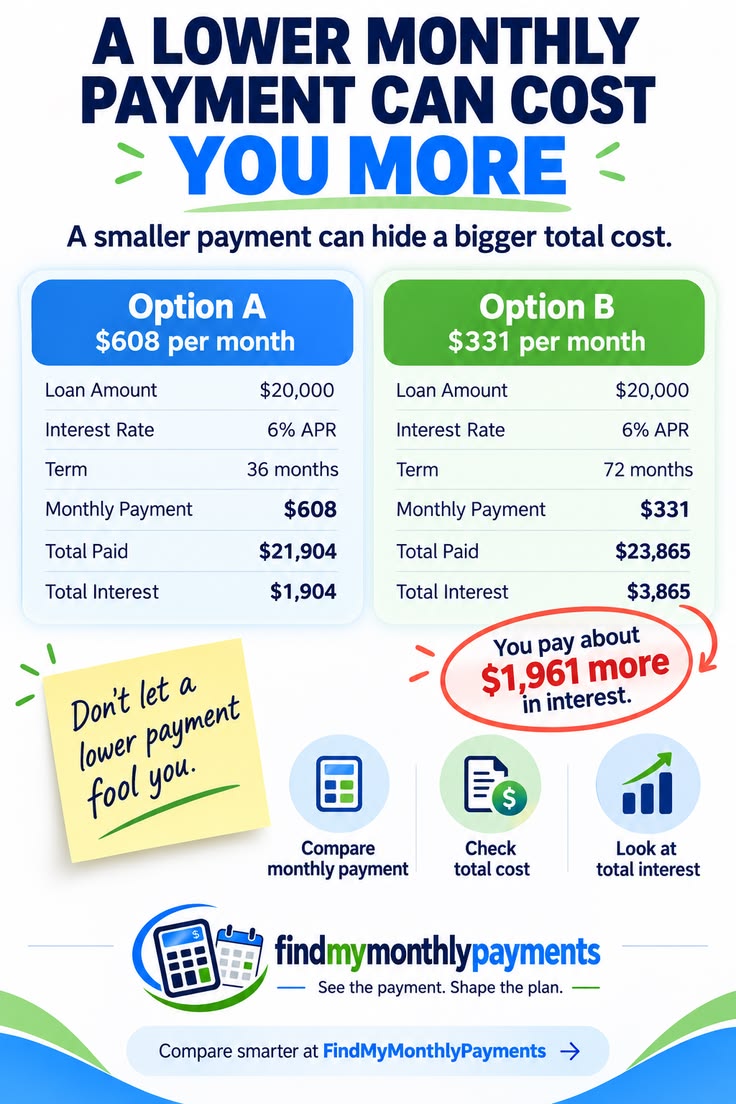
Many borrowers experiencing initial budget constraints opt for an Extended 20-year or 25-year repayment plan to lower their required monthly obligation. While this provides short-term cash flow relief, it triggers a massive increase in cumulative interest charges.
For instance, on a $50,000 loan at 6.5% interest:
- 10-Year Standard Plan: Monthly bill is $568. Total interest paid is $18,129.
- 20-Year Extended Plan: Monthly bill drops to $373 (saving $195/month). However, total interest paid balloons to $39,475—an extra $21,346 paid directly to lenders!
4. How Extra Payments Slash Principal and Interest
Because interest is calculated daily on the remaining principal balance, any additional dollar contributed beyond your scheduled monthly installment bypasses future interest charges and goes directly toward wiping out debt:
🚀 Extra Payment Impact on $35,000 at 6.5%
• Standard Payment ($397/mo): Debt free in 120 months. Total interest: $12,690.
• Add $50/mo ($447/mo): Debt free in 101 months (1.6 years early). Interest saved: $2,284.
• Add $150/mo ($547/mo): Debt free in 77 months (3.6 years early). Interest saved: $5,082.
• Add $300/mo ($697/mo): Debt free in 57 months (over 5 years early!). Interest saved: $7,341.
5. Step-by-Step Guide to Calculating Repayment in Spreadsheets
If you wish to model custom payment scenarios in Microsoft Excel or Google Sheets, you can use the built-in financial function =PMT():
Enter the formula: =PMT(rate / 12, nper, -pv)
Example: For a $40,000 loan at 6% over 10 years, write: =PMT(0.06/12, 120, -40000), which immediately returns $444.08.
6. Frequently Asked Questions (FAQ)
How do I ensure extra payments go toward principal rather than future bills?
When submitting extra payments via your online loan servicer portal, select the option labeled 'Apply as Principal Only' or 'Do Not Advance Due Date'. By advancing the due date without specifying principal allocation, some servicers simply park your money to pay next month's bill.
Does making bi-weekly payments actually lower student loan interest?
Yes! Making half-payments every two weeks results in 26 half-payments per year, which equals 13 full monthly payments instead of 12. That extra full payment each year directly attacks principal balance, shaving over a year off a standard 10-year term.
What is the difference between APR and interest rate on student loans?
The interest rate is the base cost of borrowing the principal balance. The Annual Percentage Rate (APR) incorporates both the interest rate and any upfront origination or administrative fees, reflecting the true annualized borrowing expense.

Written by Marcus Vance, CFP®®
✓ Fact-Checked & ReviewedLead Financial Aid & Student Debt Strategist
Marcus Vance is a Certified Financial Planner (CFP®®) specializing in higher education financing, federal loan restructuring, and student loan repayment optimization. He has analyzed hundreds of student debt portfolios to help graduates minimize interest and achieve debt freedom.